Into the Blue - Art Meets Evolution
September 21, 2026
If plastic is made from oil, and oil originates from organic material dating back to geological eras long past, then just how much “dinosaur” is actually in a “plastic-saur”?
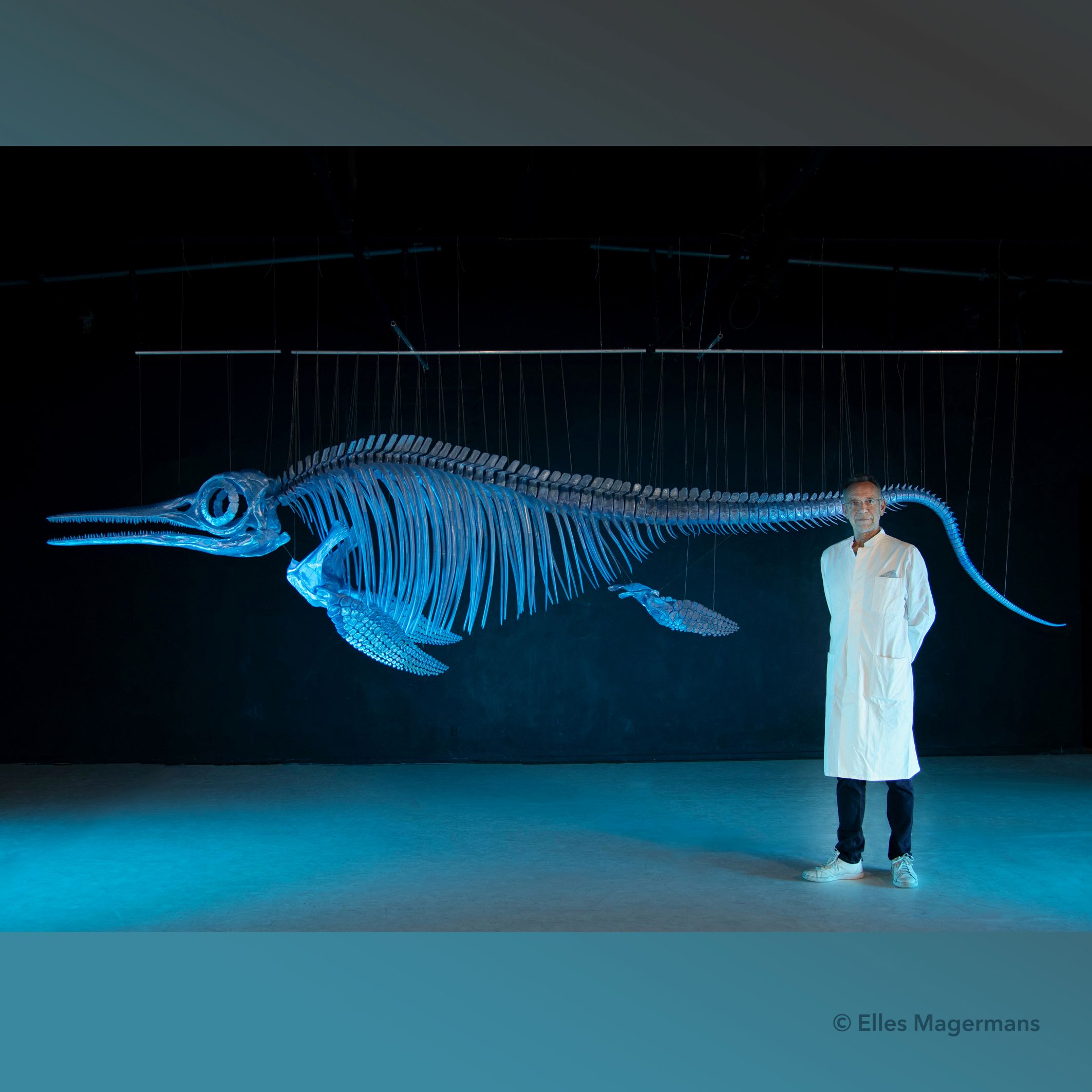
With INTO THE BLUE, Mannheim-based artist Hendrik Hackl presents a room-filling art installation at the Munich Show 2026 that connects Earth’s history, the present, and the consequences of our use of plastic. In the West Entrance, two seemingly dissimilar “swimmers” meet: the five-meter-long skeleton of an ichthyosaur and a 3.70-meter-tall human skeleton. Suspended by fine metal threads, they float toward each other above a 13-meter-long water basin. Both sculptures were created using 3D printing from a filament made of 99.97 percent recycled PET. In this way, the installation traces an impressive arc from Jurassic-era plankton through the formation of petroleum to plastic, microplastics, and their impact on our environment. The ocean serves as the connecting element: Once the habitat of the ichthyosaur and the origin of all life—today, it accumulates a large portion of the world’s plastic waste. INTO THE BLUE makes this cycle visible and, at the same time, raises the question of what traces humanity leaves behind in the Anthropocene era.
SWIMMING IN BLUE
In SWIMMING IN BLUE, the human figure itself takes center stage. A 3.70-meter-long human skeleton floats through the space in the dynamic pose of a swimmer doing the crawl. The work addresses microplastics and nanoplastics, and the fact that plastic is no longer found only in the oceans but also enters our daily lives through water, air, and food. The installation therefore deliberately poses uncomfortable questions: How much microplastic do we ingest? What are the consequences for our bodies? But also: What traces will we ourselves leave behind in the history of the Earth?
THE CLOSED CIRCLE
The five-meter-long ichthyosaur “Fritz” illustrates a cycle that began around 150 million years ago. Over geological time, organic material from ancient oceans transforms into petroleum, which is later turned into plastic—and finally, from recycled PET bottles, back into a 3D-printed dinosaur skeleton. Following its premiere in Vienna in 2024, “Fritz” was on display for the first time at the Munich Show that same year. This was followed by presentations at venues including the Museum Natur und Mensch in Freiburg and the Reiss-Engelhorn Museum in Mannheim. In 2025, THE CLOSED CIRCLE was awarded the City of Mannheim’s Environmental Prize.
THE ARTIST
Hendrik Hackl, born in 1961, lives and works as a freelance artist in Mannheim. Since 1989, he has been creating sculptures and installations featuring fossils, meteorites, minerals, and millions of years of Earth’s history. His works have been exhibited in museums, galleries, and at international exhibitions; he has had close ties to the Munich Show since his first exhibition at the Munich Show in 1989.